

Tell Me a Story: giving parents a heartstring of attachment in a tough time
Snapshot
Role: UX Designer, sole designer on the continuation: research, design and the written report
In a Neonatal Intensive Care Unit (NICU), the bond between parent and newborn is disrupted exactly when it matters most: you go from birth, to touching your baby through an incubator, to leaving them overnight.
A DJCAD and School of Medicine study on the Ninewells neonatal ward had already found that a parent's presence, and their voice in particular, is vital to a baby's brain development and bonding. I picked the project up from there. Tell Me a Story lets parents record stories and messages for their baby in a NICU, which nurses can then play when parents can't be there.
It tested well with parents who had lived through a NICU stay. What I handed over was a working proof of concept and a research report carrying six design implications and five recommendations, for whoever takes the project forward.
Constraints
Playback could never be guaranteed. As the senior neonatal nurse put it, “there would be intent to play the audio, but no guarantee, clinical duties come first.” The design had to set that expectation rather than hide it.
Safeguarding had to be visible. “We'd need a way to check it's for the right baby”, plus open questions on NHS system integration and information governance.
The prototype had to actually record audio, which pushed me onto Bubble.io. It handled the recording but restricted the design everywhere else, and being web-based added a lag between screens.
Worth noting this was pre-AI, with no assistant to lean on for the parts Bubble.io made difficult. Getting voice recording, pause, restart and playback genuinely working took longer than the design itself. I found every workaround the slow way, and shipped a prototype that actually recorded.
Start from what the class already learned
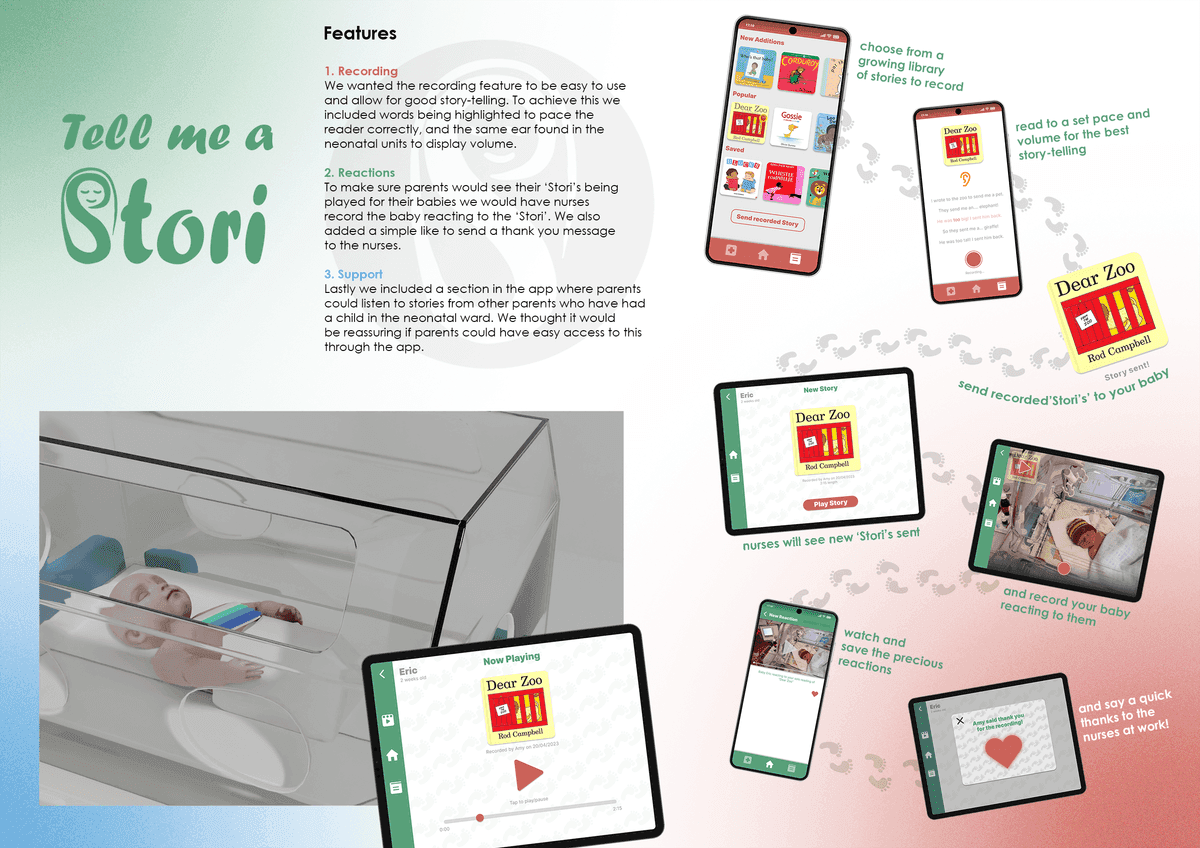
In my 3rd year of University, our class took on this project to provide some early proof of concept. I worked with a classmate of mine, Pavlin Petev. We created a simple design, record a story, send it to the hospital to play.
All of our classes projects were shared with nurses and those involved in the accompanying research project, which gave me the strengths and weaknesses of all the projects to start from.
A special story, and a sweet message
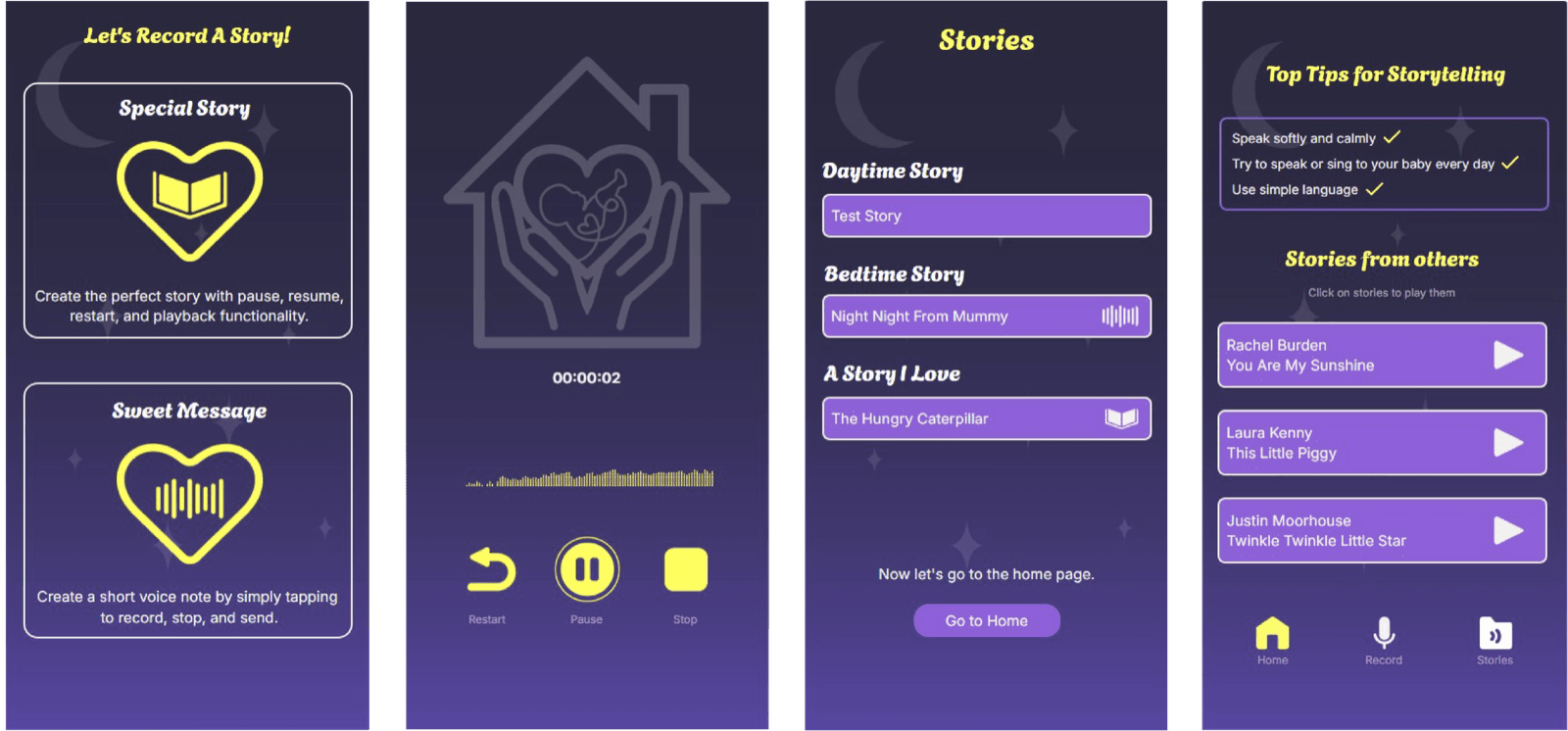
Testing early versions made it clear that one recording flow couldn't serve both intents. A parent reading a book needs to pause, restart, and hear it back. A parent saying goodnight before they leave needs one tap.
So I created two types of recordings: Special Story carries the full controls, Sweet Message behaves like a voice note. Which one a parent picks depends less on the feature, and more on how much you have left in you that day.
Make it warm, not medical
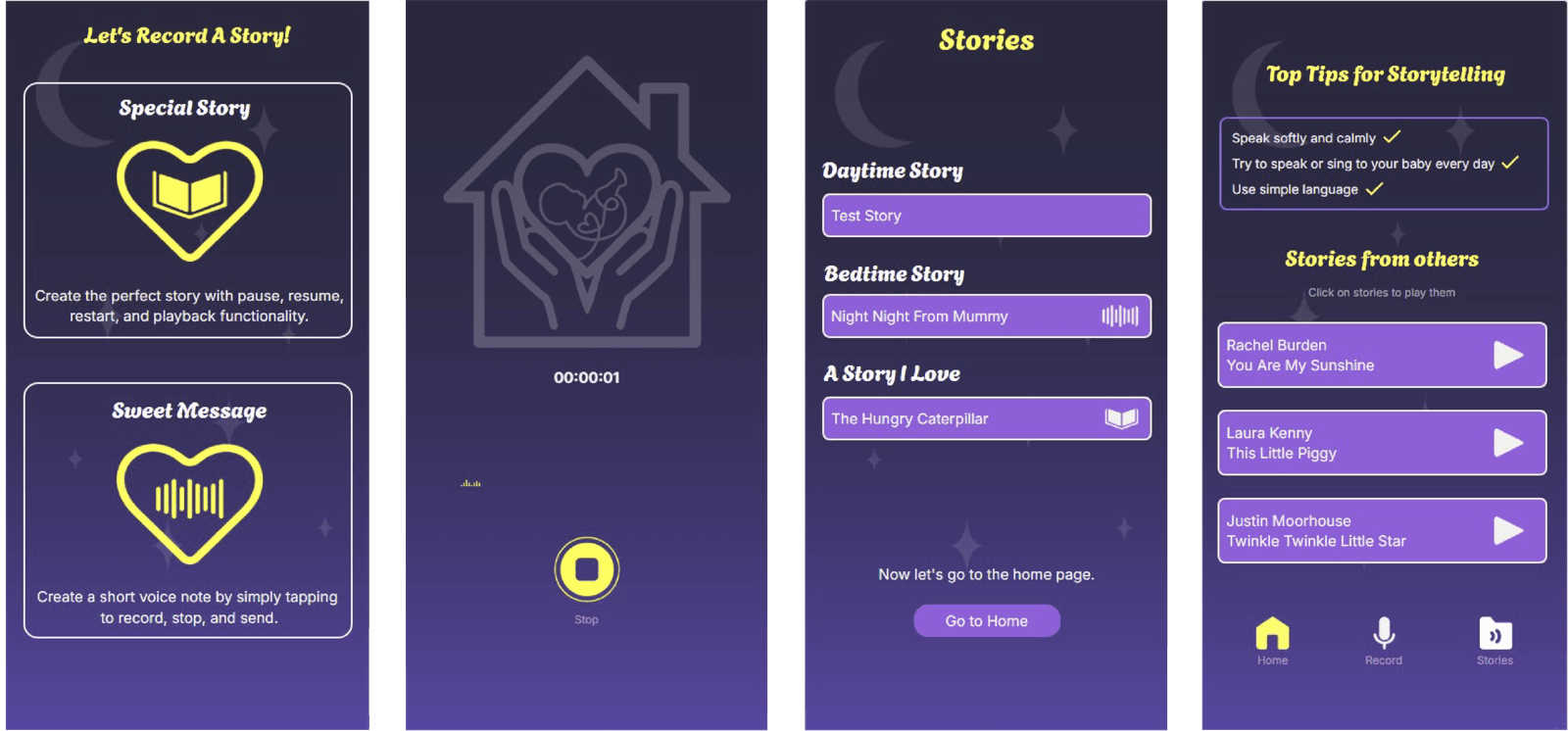
The Ninewells NICU in Dundee is deliberately softened with illustrations. I took a similar line: nothing that reads as clinical or cold. Red was ruled out entirely; in that environment, it means emergency.
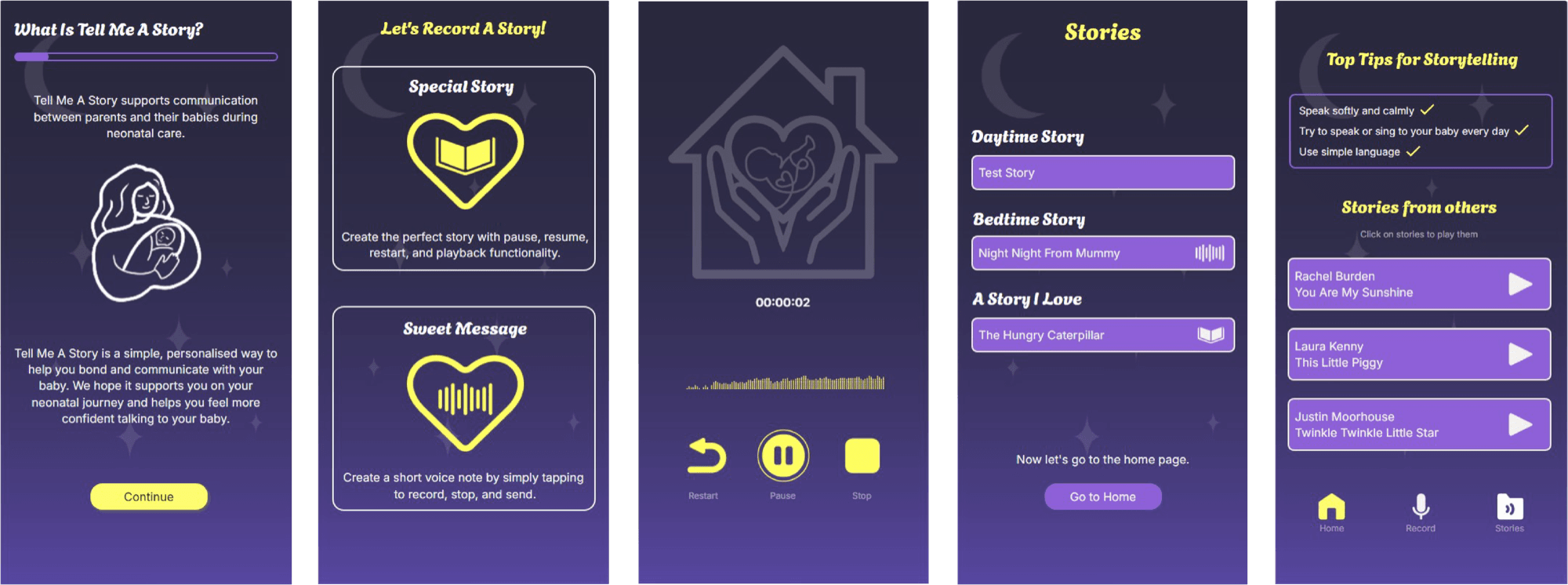
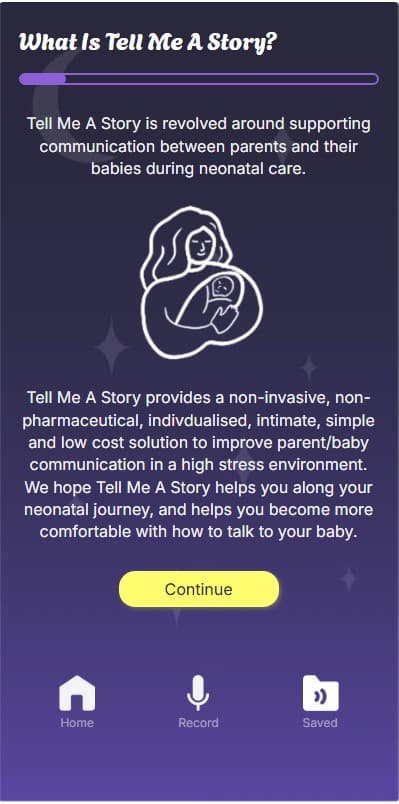
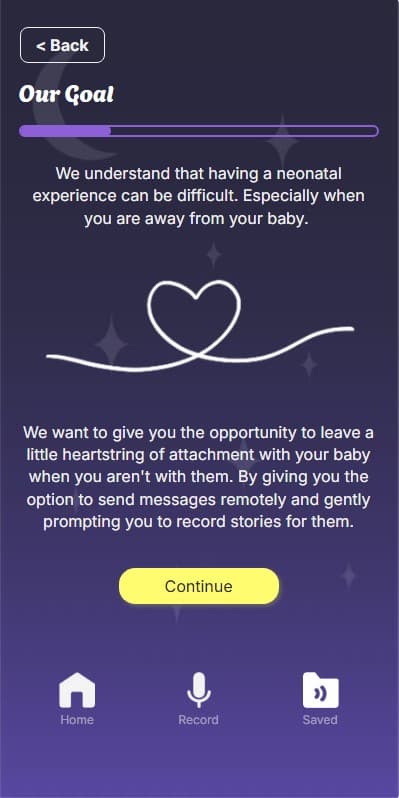
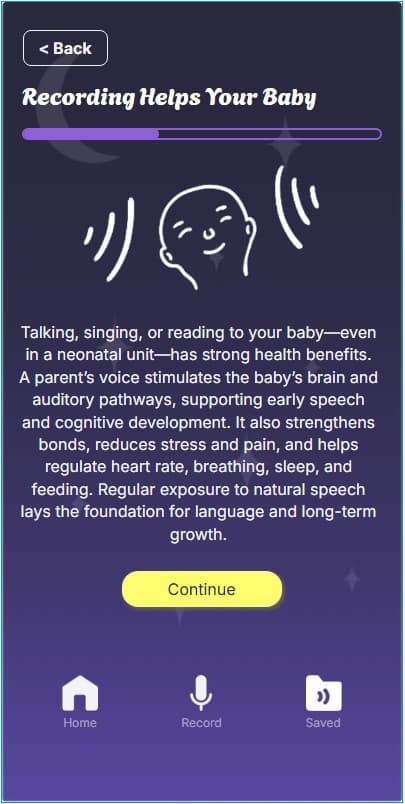
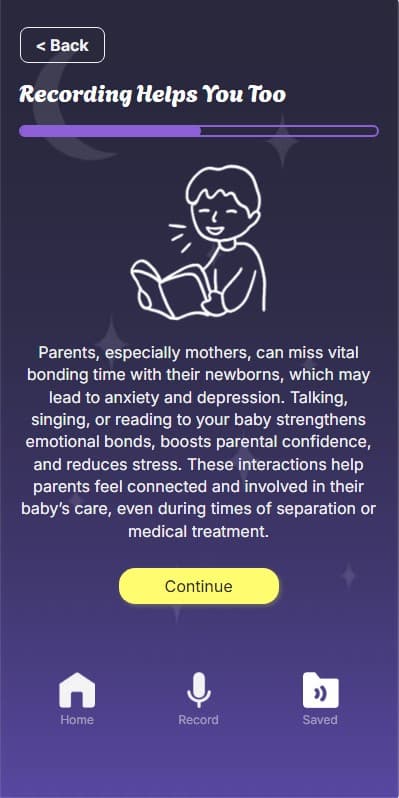
The reference point became children's books, and the design settled on a night sky with a glowing yellow. The onboarding does the expectation-setting the nurse asked for, and one of her phrases, “anything that leaves that little heartstring of attachment,” made it into the app itself.
Talking to parents who have been through it
We ruled out talking to any parents who had a baby currently in the NICU, it would've been invasive and inappropriate. Recruitment was limited to parents within five years of their experience, recent enough to recall.
17 people showed interest, 11 completed ethics, 6 tested: a 35% conversion with no incentive offered beyond interest in the project. All six participants were female and UK-based, since the concept targeted the NHS. That is a real gap: the app speaks to parents, but I only heard from mothers.
Each session ran up to an hour, split three ways. Around five minutes of icebreaking, to understand that parent's own neonatal experience. Then 10 to 15 minutes of free roam on the prototype, thinking aloud. The rest went on 13 semi-structured questions, with follow-ups wherever an answer opened something up.
The 13 questions I asked
- How did you find the onboarding process? How clear and helpful was it? Why was this so?
- How does the ability to record and send audio to the hospital help you overcome communication barriers with your infant?
- In what ways did any visual feedback during the recording process affect your approach to recording your voice?
- How intuitive was the process of recording and reviewing your audio message?
- Did you feel confident that your recording would successfully be played for your baby?
- Did the app provide enough information about how your recordings would be managed by the nursing team at the hospital?
- What did you think of the different types of stories and how they can be managed?
- Do you think the information and stories on the home page were helpful?
- What did you think of the language used in the app?
- Were there any of the features in the app that may help you to alleviate stress and anxiety? If so, what were they and why?
- Is there anything you would change to help make the experience more comforting for you?
- Would you recommend this app to parents of neonatal infants?
- Are there any other thoughts you had on the prototype?
Shipped
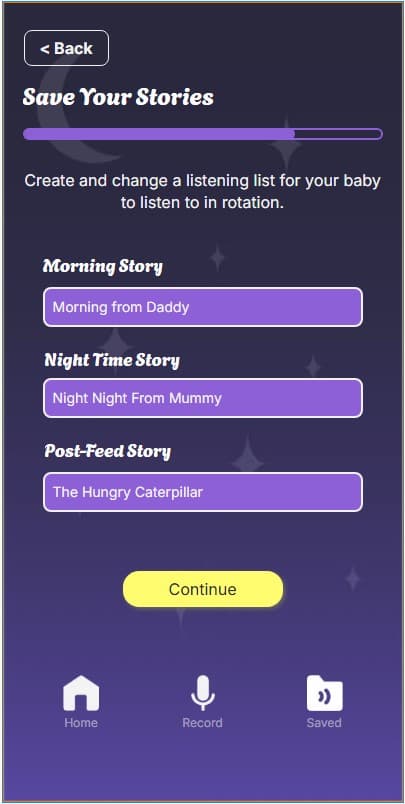
A working high-fidelity prototype in Bubble.io with functional voice recording: onboarding, the story-type fork, recording with playback, a Stories page (Daytime, Bedtime, A Story I Love), and a Home page of storytelling tips.
Alongside it, a full research report, protocol, participants, findings, emerging themes and recommendations, plus the nurse-side requirements that fell out of scope.
Impact
The tone landed exactly as intended. One parent described it as “communicated in a compassionate and sensitive way”. They set that against an existing neonatal app that “wasn't a very visually pleasing system”. Another said that “just knowing they could still hear your voice would have helped”.
The willingness to take part was its own finding. Six parents each gave up to an hour to revisit one of the hardest periods of their lives. The only incentive was caring about the project.
I wrote up the findings as six design implications: bonding through audio, the need for normalcy, language, emotional load, guilt, and visual design. From those I set out five recommendations and a feature shortlist for whoever picks the project up next.
Reflection
This is the most human-centred project I've ever worked on. Working so closely with Sarra Hoy, who sponsored the project and had not only gone through the experience herself but also advocates for others through the Bliss charity, was truly special.
Testing it with parents who were so genuinely invested in the project's success, and who wished they'd had something like it at the time, was probably the most rewarding experience of my career so far.
The craft lesson was designing around a constraint I couldn't remove. Playback could never be promised, because clinical duties come first. The honest move was to say so in the onboarding rather than let a parent assume otherwise. I'd also push harder for time with the nurses: I designed the parent side thoroughly and left theirs as requirements for someone else to pick up.